The Sourdough Test: What Happens When You Give the Skeleton a Soul?
In my last post, I laid out a simple argument: the reason most gluten-free bread fails isn't the flour. It's the framework. Build a real structural system first: a scald, a strong psyllium network, high-protein gluten-free grains working together… And then the bread has somewhere to go. Fermentation can do its actual job instead of being asked to hold up a building with no frame.
Four yeasted bakes proved that out. By bake four I had a poke test that responded, visible proofing activity, an open even crumb, and real lift. The structure was working.
But yeasted bread has limits. Instant yeast produces CO2 and not much else. It doesn't break down starches. It doesn't produce acids. It doesn't have the microbial complexity to develop flavor the way a living culture does. The yeasted formula was always a proof of concept, not a final destination.
The next question was obvious: what happens when you give the skeleton a soul?
Why sourdough changes the equation
A sourdough starter isn't just a slower version of commercial yeast. It's a whole ecosystem. Wild yeast for leavening, lactic acid bacteria producing both lactic and acetic acids, enzymes breaking down starches and proteins over time. In wheat baking we lean on sourdough for flavor and complexity. In gluten-free baking it has the potential to do something more fundamental.
Here's the technical part worth understanding: lactic acid produced during fermentation makes psyllium gel more extensible over time. The acid softens the network. A psyllium gel that's been sitting in an acidic environment for several hours has more give than one that's been mixed and immediately shaped. More extensibility means the structure can hold more gas before it reaches its limit.. Which translates directly to more lift, more open crumb, and better oven spring.
At the same time, the enzymes in an active starter (amylases, mostly) are breaking down starch chains during the bulk ferment. This addresses one of the persistent flavor problems in the yeasted series: that faint starchy taste that comes from starches that haven't been fully broken down before bake. Longer fermentation with an active culture means more of that work happens before the loaf ever hits the oven.
In short: sourdough doesn't just leaven gluten-free bread differently. It makes the structure more capable and the flavor more complex simultaneously.
Sourdough test one
My sorghum starter has been building for several weeks at this point. Active, sour, with a clear yogurt-to-floral progression that told me the microbial community was healthy and diverse. I built this recipe on the same structural foundation as the yeasted formula: scald of the sorghum portion, psyllium at the same percentage, oat flour for protein and extensibility.
The difference was immediately visible in the crumb. Where the yeasted bakes produced a relatively uniform, fine cell structure, the sourdough crumb was irregular. Varying bubble sizes distributed throughout, the kind of uneven openness you see in a well-fermented wheat sourdough. That irregularity isn't a flaw. It's fermentation character. It's the difference between a system that's producing gas at a steady mechanical rate and one that's alive and working in a more complex way.
The lift was real. The crust color was deep. The poke test had responded exactly as it should: slowly, with resistance, telling me the structure was loaded and ready.
It was dense, like a high-rye bread. Not dense like an underproofed loaf. There's a difference and it matters. High-rye density is character. Underproof density is failure. This was the former.
There was a small amount of banding, some lateral spread, and a crumb that told me fermentation hadn't gone quite far enough. But the structure held everything it was given. The skeleton did its job. The sourdough just needed more time to do its job too.
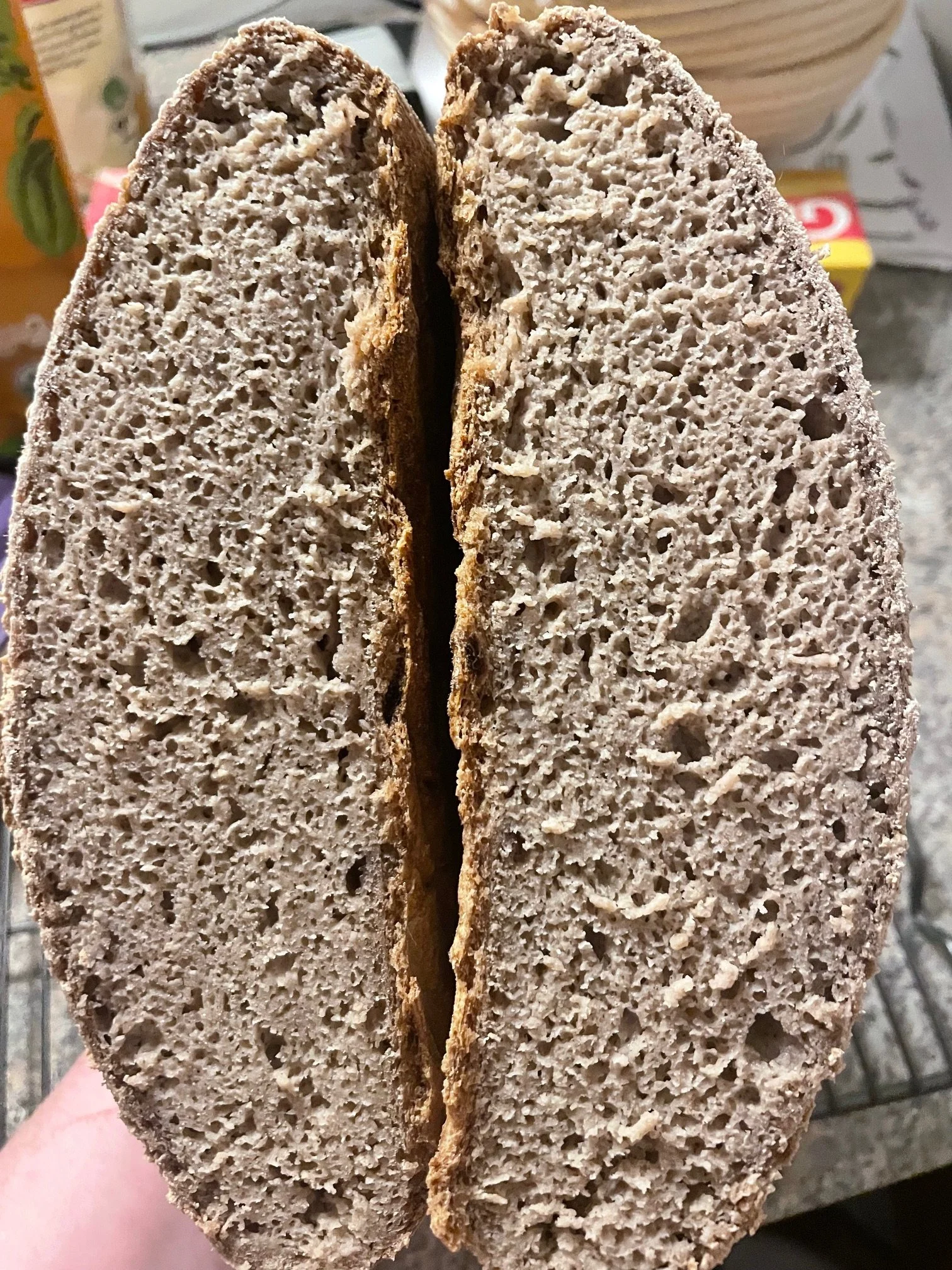
Gluten Free Sourdough Test One
Sourdough test two: cold retard
The adjustment going into test two was simple: give it more time. A longer bulk before shaping, a short post shape ferment, and then an overnight cold retard in the banneton before baking straight from the fridge.
Cold fermentation does a few specific things worth naming. It slows yeast activity dramatically while lactic acid bacteria continue working at a reduced but meaningful rate. This means the flavor keeps developing without the dough overproofing. It also firms up the psyllium gel structure, making the dough easier to handle and giving the surface tension more integrity going into the oven. And baking cold dough straight from the fridge into a screaming hot oven creates a dramatic temperature differential that drives aggressive oven spring.
The result was the best loaf of the tests so far. Taller, deeper color, more complex flavor. While slightly denser than test one, the crumb showed real lift in the cross section. You could see the height in the way the cell structure was distributed from top to bottom. Open and irregular throughout, only slight gumminess, no meaningful banding. All from simply being too nervous to let the dough do it’s thing.
It tasted delicious. Sour without being sharp. Earthy from the sorghum. A little sweet from the oat. Dense in the way that good whole grain bread is dense. Satisfying rather than heavy. While the crumb in test one is a little more open, test two proved that the starchiness can be fermented out of a gluten free loaf, that lactic acid bacteria are incredible at doing their jobs, and that the techniques I’ve been using for years are not lost on a different system of structure.
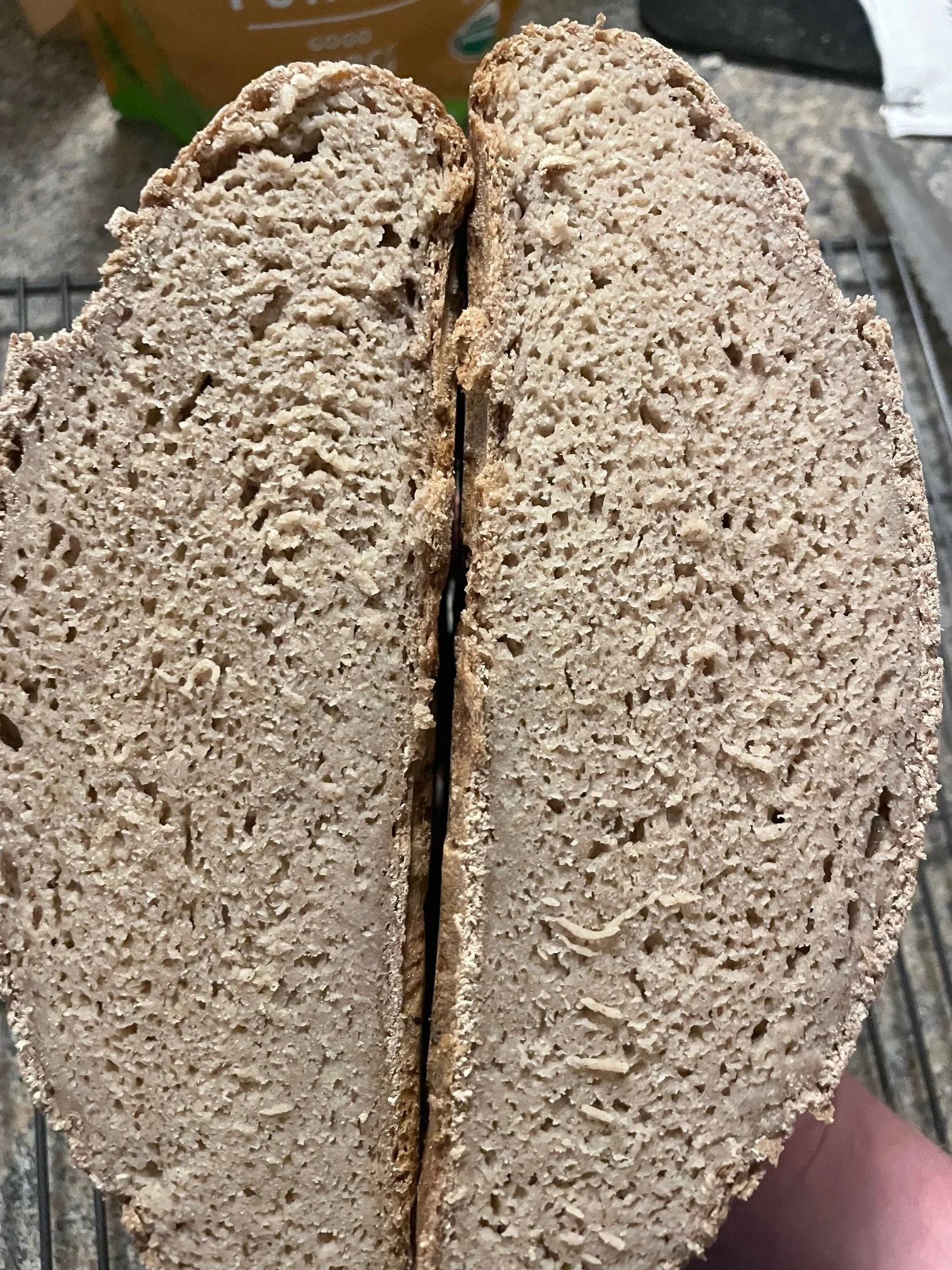
Gluten Free Sourdough Test 2
What's changing next
Every bake teaches something specific. Here's what test two told me:
The scald percentage is coming down slightly. The pre-gelatinized starch is doing structural work, but there's a point where too much of it limits the extensibility the psyllium and oat network is trying to provide. Rebalancing toward more fermentation-driven structure and less scald-driven structure should open the crumb further.
Sorghum and oat are moving toward equal parts. More oat means more protein, more beta-glucan, more extensibility baked into the flour ratio before psyllium even enters the equation. It also pulls the flavor profile toward something slightly less earthy and more bread-like without losing the character of the grains.
Fermentation is the main focus in this test. These starches are capable of being pushed further, giving a slightly longer post shape ferment before overnight fermentation. More time proofing means more time for acid development, more enzymatic starch breakdown, more extensibility built into the psyllium network before shaping. These starches ferment more slowly than wheat. Giving them the time they actually need rather than compensating with more starter or yeast is going to really bring out those flavors and transform the dough.
The cold retard proved its value. But the dough needs to arrive at the fridge with more fermentation activity behind it. A longer, warmer bulk gives the structure more gas to work with going into the cold and produces a more developed crumb out of the oven.
The pattern
Looking across all six bakes now, the pattern is consistent. Every time I've given this system more time and trusted the structure to hold it, the result has improved. Every time I've pulled back out of habit or caution, the banding and density have told me exactly where I left time on the table.
The structure can hold more than I keep giving it credit for. That's the lesson that keeps repeating itself.
The sourdough version isn't finished yet. But it's already doing things the yeasted version couldn't. More lift, more complexity, more fermentation character in the crumb. The hypothesis from my yeasted trials is holding: build the skeleton first, and everything else has somewhere to go.
Next up is longer bulk, lower inoculation, equal parts sorghum and oat, reduced scald. And then we'll see what this system is actually capable of.
