How to Know When Your Sourdough Starter Is Actually Ready to Use
Can I tell you something I see all the time?
Someone cuts open a sourdough loaf, sees a tight crumb, and immediately decides they failed. They blame themselves. They blame their technique. They start questioning whether their starter is even alive.
And often, when I hear the details, the bread didn't fail. The starter just wasn't ready yet.
There's a big difference between those two things. And I think it's worth slowing down to talk about it.
The 12-Hour Rule Isn't Actually a Rule
Somewhere along the way, "feed your starter and use it after 12 hours" became gospel. I hear it constantly. I see it in comments, in tutorials, in beginner guides written with total confidence.
But here's the thing: 12 hours is a timestamp. It is not a readiness indicator.
Your starter's activity timeline depends on your kitchen temperature, the flour you used to feed it, your feed ratio, the composition of your culture, and how long you've been maintaining it. Someone writing a recipe in a warm kitchen with a young, yeast-forward starter is working with completely different variables than you are. Their 12 hours might not be your 12 hours.
When you use an immature starter, you're seeding your dough with a culture that hasn't fully done its job yet. The yeast population isn't at full strength. The fermentation hasn't produced the acids and gases that give sourdough its structure and flavor. You're asking the dough to do a lot of work with a tool that isn't quite ready.
The result is often a dense loaf. And then people think they failed.
They didn't. They just used their starter too early.
Hungry vs. Immature: Not the Same Thing
Here's something I actually find reassuring: I would rather use an over-fermented starter than an under-fermented one.
A starter that's gone past peak is hungry. The culture is strong and established. It has already done the work of building a healthy microbial population. It's burned through a lot of its available sugars and it wants fresh food, but the moment it hits new flour it tends to move quickly and with confidence.
An immature starter is a different situation. The population hasn't fully developed yet. You don't entirely know what you're working with. And that uncertainty shows up in the dough.
A mature starter, even one that's a little past its peak, is a known quantity. An immature one isn't.
I Baked This Experiment So You Could See It
I wanted to make this concrete, so I baked the same recipe twice and changed only one thing: when I used my starter.
Both loaves used all-purpose flour, 65 percent hydration, 20 percent starter. Same shaping. Same oven. Same Dutch oven setup. My starter is a spelt-forward culture that I maintain at a 1:3:3 ratio, which tends to favor lactic acid bacteria and a slower, more gradual fermentation curve. For this culture, full maturity usually happens somewhere around 20 to 24 hours post-feed.
Loaf one used starter at 11 hours. Visibly active, clearly fermenting, but short of where this particular culture needed to be. I used it early on purpose.
Loaf two used starter at around 20 hours. Past peak, technically. But fully developed.
The differences showed up before either loaf went into the oven.
The mature starter was noticeably more liquid at incorporation. Longer fermentation means more enzyme activity, which had already begun loosening the protein structure in the starter flour. The dough felt more extensible almost immediately and passed the float test within the first two hours of bulk. The loaf one dough was stiffer and moved more slowly the whole way through.
The crumbs told the same story:
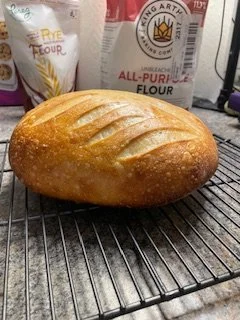
Loaf One
Tight, even, dense. Beautiful crust. Great color. Good flavor, actually, because the dough itself had a long fermentation built into the process. Dense, but not a disaster. Informative.
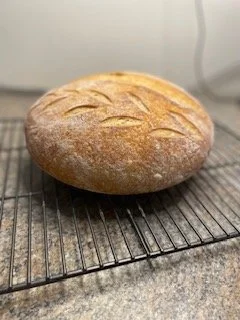
Loaf Two
open, irregular crumb with visible gas retention throughout. Strong oven spring. More complex flavor.
Dramatically different result from the same recipe, the same hydration, and the same hands.
One variable.
Dense Bread Is Telling You Something
I want to be clear about something: density has more than one cause. Low hydration produces a tighter crumb. So does underproofing, weak gluten development, improper shaping, and too much bench flour. These are distinct issues with distinct solutions.
Immature starter is one specific cause that often gets lumped into a vague sense of overall failure.
It's also worth saying: some bakers intentionally cultivate a culture that favors lactic acid bacteria over yeast. That culture will ferment more slowly, produce a different flavor profile, and make a denser loaf than a yeast-forward starter. That is not a flaw. It is a choice. The bread it makes is not failing to be something else. It is exactly what it was designed to be.
Before you decide your bread failed, ask what it's telling you.
A dense crumb with good color, good crust, and good flavor is a loaf that worked. It just worked differently than the image you had in your head.
So How Do You Know When Your Starter Is Ready?
Stop watching the clock. Start watching the starter.
A mature starter will have visibly risen, developed bubbles throughout, and have a domed or slightly fallen top. It will smell active and tangy. A small amount dropped in water will float, or at least make its way toward the surface. The texture will have loosened from how it looked right after feeding.
These signals will look a little different depending on your culture. That's the point. Your specific microbial community has its own rhythm. Getting familiar with that rhythm, what your starter looks and smells and feels like at different stages, is more useful than any rule about hours.
This is the part of sourdough that takes practice. Not because it's complicated, but because it's observational. You're learning to read something that's alive.
And that, honestly, is one of my favorite things about it.
Dense bread isn't a failure. It's a starting point for a better question.
Want to know more about what’s happening in your sourdough starter? Check out the Science of Sourdough Starters
